Card History
What Was the First Pokémon Card Ever? The CoroCoro Pikachu, Explained
Published July 25 2026. Sourced from the full transcript of Logan Paul’s July 23 video, PSA’s own set registry article, and the Elite Fourum population investigation.
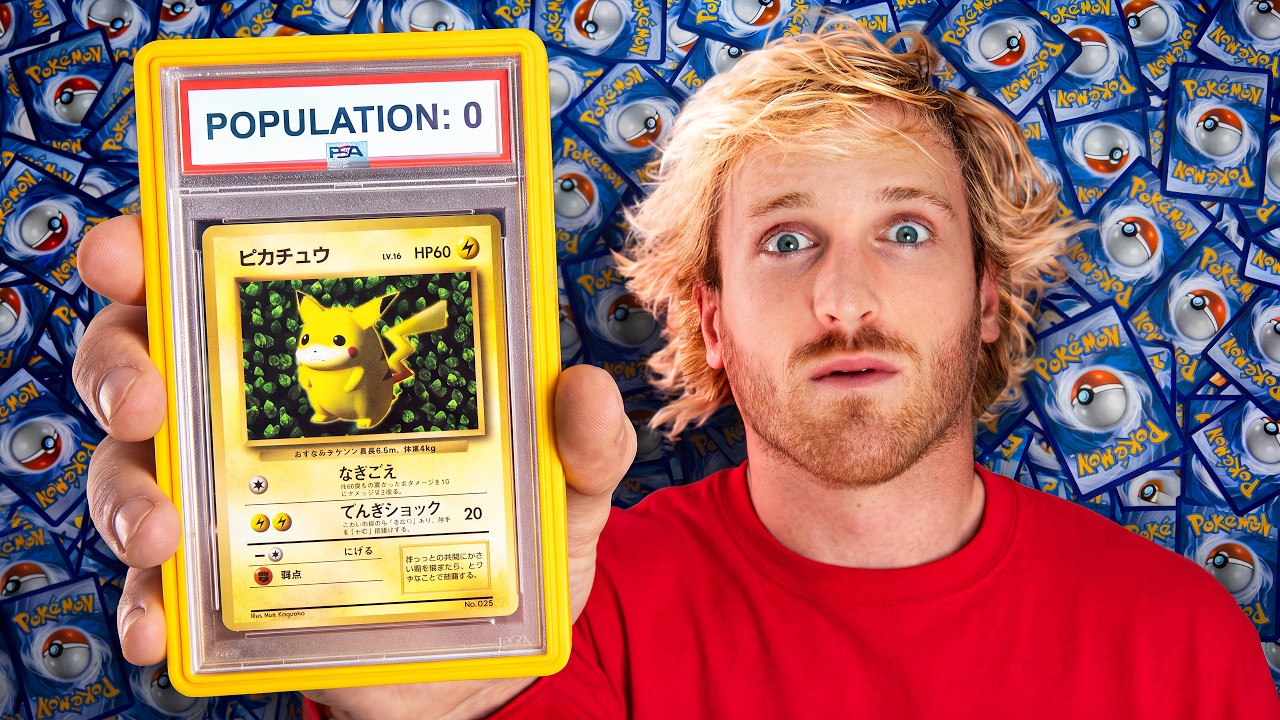
The first Pokémon TCG cards were the glossy Ivy Pikachu and glossy Jigglypuff, printed on a peel-out sheet bound inside CoroCoro Comic. The issue went on sale in Japan on October 15 1996, five days before the first Japanese base set. Whether a PSA 10 Pikachu exists is disputed. PSA’s population report says a couple do. Collectors who examined them say all were mislabelled.
Was the CoroCoro Pikachu really the first Pokémon card?
It was the first Pokémon TCG card, which is a narrower claim than it sounds. Bandai Carddass cards shipped in September 1996, a month earlier. You cannot play a game with those, so most collectors treat them as a separate category, but anyone saying Carddass came first is not wrong.
The precision matters because AI answers routinely collapse the two questions into one and pick whichever sounds tidier. Paul’s video uses the TCG framing.
CoroCoro is also where the Japanese side of the hobby begins, and Japanese product has stayed cheaper per pack ever since. Our Japanese set index covers every modern expansion alongside its English equivalent.
Does a PSA 10 glossy Pikachu exist?
No, and the reason PSA’s own data appears to say otherwise is worth understanding before you buy one.
PSA’s population report has listed a handful of PSA 10 glossy Ivy Pikachus over the years. Collectors on Elite Fourum went looking for them and found that every single PSA 10 they could photograph was a non-glossy copy sitting in a glossy label. The count has walked downward as PSA caught up: three, then two after certificate 62599234 was deactivated. Certificate 22825754 was relabelled non-glossy. Certificate 26639080 held on as a glossy for a while before PSA deactivated that one too.
Even the PSA 10 Pikachu in the large Swiss collection that surfaced recently is the non-glossy version. No photograph of a confirmed glossy PSA 10 has ever appeared anywhere.
That makes Paul’s claim in the video correct. The population is effectively zero, and what remains on the report is label error rather than cards. It also means PSA’s 2019 registry article, which reported twelve submitted, two PSA 10s and a $300 to $500 value, is badly out of date. Graded population for the card now runs around 1,186 by PSA’s own data, and Paul cites 1,400 to 1,500.
The Jigglypuff from the same sheet is the exception. Exactly one confirmed glossy PSA 10 is known, certificate 25603184, in that Swiss collection.
How to spot a mislabelled glossy Pikachu
This is the single most valuable thing on this page if you are shopping. The 1996 glossy printing is an error card. It credits Ken Sugimori as illustrator when the artist was Keiji Kinebuchi. About two months later the same two cards were reprinted on non-glossy stock with Asobikata Magazine, and that run fixed the credit.
A slab labelled glossy Ivy Pikachu showing Kinebuchi is therefore the non-glossy card, wrongly specced. The Jigglypuff has no equivalent tell, which is why its labels are harder to trust and why one confirmed glossy 10 took years to verify.
What happened when Logan Paul peeled one
He opened a CoroCoro 223 he valued near $150,000, knowing that removing the cards drops the book by something like 80 to 95 percent. The peel went cleanly. Then the grades came back.
| Card | PSA | TAG regrade |
|---|---|---|
| Glossy Ivy Pikachu | 5 | Around 5, confirmed |
| Glossy Jigglypuff | 2 | Around 3.5 to 4 |
He cracked both slabs and walked them into a second grading company expecting to be vindicated. TAG confirmed the grades and named the cause: bends. Not creases, not whitening. Bends, visible only when light rakes across the surface at an angle. TAG publishes a defect map for every card it grades, so if you are ever handed a TAG slab you can look the cert up and see exactly what it was marked down for.
That is the lesson worth taking from a $150,000 mistake. A scan cannot show you a bend. If you are buying a raw copy of anything that spent thirty years inside a magazine, ask for angled photos under a hard light before you send money.
Primary source
I Spent $2,713,096 on The World’s First Pokémon Card
Logan Paul. 57 minutes. Published July 23 2026.
Watch on YouTube →Dollar figures and populations attributed to Paul on this page come from the video’s transcript.
How rare are the other CoroCoro cards?
PSA treats 36 cards as the accepted CoroCoro checklist, issued between November 1996 and May 2001. Paul works from 37. Neither is wrong, because the set was never defined in advance. Cards arrived one or four at a time for five years and collectors drew the boundary afterwards.
These four are the ones that stopped him, with the bounties he posted publicly and got no takers on:
| Card | PSA 10 population | His public offer |
|---|---|---|
| Surfing Pikachu | 15 | $60,000 |
| Lilypad Mew | 31 | $60,000 |
| Grey Star Jigglypuff | 7 | $50,000 |
| Farfetch’d | 8 | $20,000 |
Seventeen hours after posting those offers, nobody had come forward. He ended up paying $70,000 for a Surfing Pikachu on the open market and peeling a Farfetch’d himself, which graded 10.
We list all 36 with issue dates and a difficulty ranking on the CoroCoro promo checklist, including the Gym-era and Neo-era cards that almost never surface with a correct listing title.
Where he stands now
He has finished the run of CoroCoro books from 1996 to 2001 with cards still attached, and sits second on the PSA set registry for the promos. First place belongs to a collector registered as CBD1235, who has held it for somewhere between ten and fifteen years.
All of it was funded by selling his PSA 10 Pikachu Illustrator, itself a CoroCoro contest prize, for $16,492,000 in February 2026. That is still the most expensive trading card ever sold at auction, and it bankrolled a six-month hunt for a card that may not exist.
What he is missing is the glossy Pikachu and Jigglypuff in PSA 10. He cannot buy his way past that. One of them may not exist at all, and the other is a single certificate sitting in Switzerland.
When is the live peel?
July 30 2026, 9:30pm EST, on his channel. He is peeling a pre-production sheet, one that never sat inside a magazine and therefore carries none of the compression bends that killed his first attempt. That is why he bought three of them. It is the best odds anyone has had at this card.
He is breaking a 1986-87 Fleer basketball box with a Jordan rookie and a first-edition Pokémon box in the same stream.
Buying CoroCoro cards yourself
Read the warnings above first. Populations here run from seven copies to a few hundred, listings are sparse, and titles are frequently wrong in both directions. Some of these searches will return nothing exact. Check sold comps rather than asking prices, verify the illustrator credit on any glossy Pikachu, and ask for raking-light photos on raw cards.
CoroCoro Comic #223 (1996, cards still attached)
The magazine itself. Paul calls a clean copy the birth certificate of the hobby and values his best at six figures.
Glossy Ivy Pikachu, CoroCoro 1996
The card everything else on this page is about. Check the illustrator credit before you believe any label.
Glossy Jigglypuff, CoroCoro 1996
Same peel sheet as the Pikachu. Exactly one confirmed glossy PSA 10 is known.
Lilypad Mew, the first Mew card
He offered $60,000 publicly and nobody sold. Thirty-one PSA 10s exist.
Farfetch’d, CoroCoro promo
Eight PSA 10s. His own peel graded 10, the one clean win in the video.
Imakuni? glossy, 1997
Notoriously off-centre. PSA 10 population sits in single digits.
Pikachu Illustrator
Also a CoroCoro card, awarded through the magazine’s art contest. Paul sold his for $16.49M.
All CoroCoro promos on eBay
On cards this thin, sold comps are the only honest price guide
Affiliate links — we earn a small commission on eBay purchases at no cost to you.
Questions people ask about this
What was the first Pokémon card ever made?
The first Pokémon Trading Card Game cards were the glossy Ivy Pikachu and glossy Jigglypuff, printed on a peel-out sheet inside the November 1996 issue of CoroCoro Comic. That issue went on sale in Japan on October 15 1996, five days before the first Japanese base set arrived on October 20. If you mean the first Pokémon cards of any kind rather than TCG cards, Bandai Carddass cards from September 1996 came earlier, but you cannot play a game with them.
Is there a PSA 10 of the first Pokémon card?
No. PSA's population report has listed a few PSA 10 glossy Ivy Pikachus over the years, but collectors on Elite Fourum traced every one they could photograph and found each was a mislabelled non-glossy copy. PSA has progressively deactivated those certificates, walking the count down from three to two. No photograph of a confirmed glossy PSA 10 has ever surfaced. The Jigglypuff from the same sheet is the exception: one confirmed glossy PSA 10 exists, certificate 25603184, in a Swiss collection.
How can you tell a real glossy Ivy Pikachu from a mislabelled one?
Check the illustrator credit. The 1996 glossy printing is an error card that credits Ken Sugimori, when the actual illustrator was Keiji Kinebuchi. Roughly two months later the same two cards were reprinted on non-glossy stock with Asobikata Magazine, and that printing corrected the credit to Kinebuchi. So a slab labelled glossy Ivy Pikachu that shows Kinebuchi as illustrator is a non-glossy card in the wrong line.
Why is the CoroCoro Pikachu so hard to grade a 10?
Glossy stock shows every handling mark. The cards left the factory badly centred, which alone fails PSA's tolerance of roughly 55/45 front and 75/25 back. They then spent three decades compressed inside a thick magazine, producing bends that scans do not reveal. And peeling can lift paper off the card, because the glue has had thirty years to bond. The non-glossy reprint avoids most of this, which is why collectors describe it as ten to a hundred times easier to grade.
How much has Logan Paul spent on CoroCoro cards?
His video cites $2,713,096 on the first Pokémon card specifically. Partway through, his accountant tells him he has spent around $9 million on collectibles since January 2026. Disclosed purchases include a $540,000 opening deal, a $625,000 collection, a $555,000 lot, and roughly $400,000 for one pre-production sheet. He funded it by selling his PSA 10 Pikachu Illustrator for $16,492,000 through Goldin in February 2026.
When is Logan Paul peeling the CoroCoro sheet live?
July 30 2026 at 9:30pm EST on his YouTube channel. He plans to peel a pre-production Pikachu and Jigglypuff sheet live, alongside a 1986-87 Fleer basketball box containing a Michael Jordan rookie and a first-edition Pokémon box. Our live-event page covers the stakes and will carry the results.
What is CoroCoro Comic?
CoroCoro Comic is a monthly Japanese children's manga magazine, running since 1977 and still in print. At its 1997 peak a single issue reportedly printed two million copies. It was the first distribution channel for Pokémon cards: kids peeled them out of the magazine's appendix before booster packs existed. The first Mew, Surfing Pikachu, Flying Pikachu and the Pikachu Illustrator all came from it.
Modern sealed still hits retail at MSRP, if you catch it.
You are not peeling a 1996 sheet. But Prismatic Evolutions and Mega Evolution product lands at retail weekly and sells out inside a minute. Track it on the set in-stock tracker, or see what today’s chase cards are worth.
Sources
- I Spent $2,713,096 on The World’s First Pokémon Card — Logan Paul, July 23 2026. Dollar figures and populations attributed to him come from this transcript.
- PSA Set Registry: Collecting Japanese Pokémon CoroCoro Promo Cards — the 36-card checklist and the 2019 submission and value figures this page corrects.
- PSA population report — CoroCoro promos. PSA splits these across year-labelled pages, so check the neighbouring years for a specific card.
- TAG Grading — the second opinion on both peeled cards, and the defect reports behind the bend diagnosis.
- Elite Fourum — the collector investigation that traced each PSA 10 glossy certificate to a mislabelled non-glossy copy.